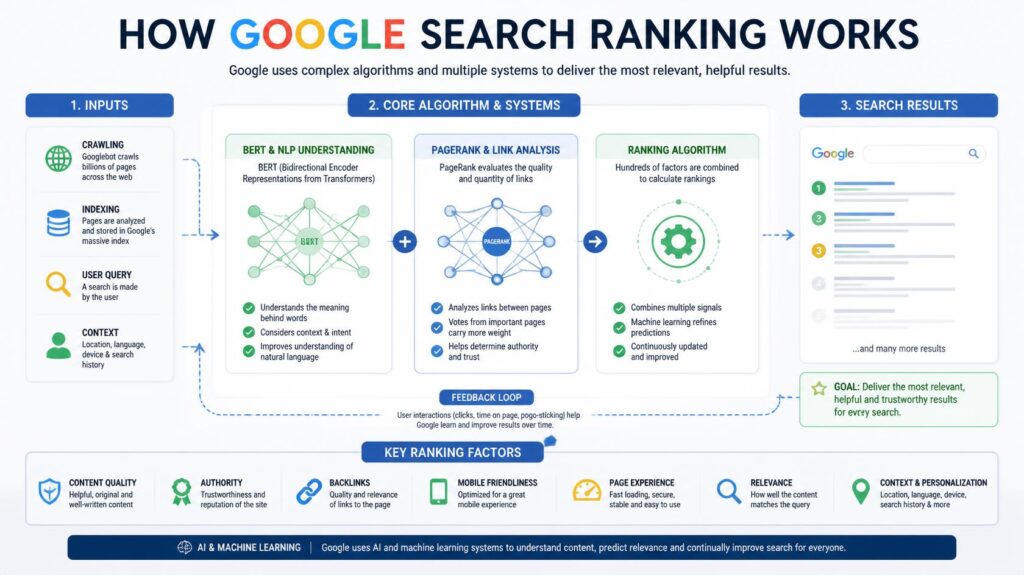
The Google Search Engine Ranking Algorithm and SEO Ranking Factors Explained
Achieving a top position on the Search Engine Results Pages (SERPs) relies entirely on understanding how the Google Search ranking algorithm evaluates web pages. This comprehensive breakdown decodes every critical system driving organic search visibility today.
What is the Google Search Ranking Algorithm?
The Google Search ranking algorithm is a complex matrix of automated background systems used to calculate website relevance. It dynamically assesses specific quality signals to deliver the most accurate, helpful search results for target user keywords.
The Google Search Ranking Algorithm is not a single code blueprint, but a highly complex ecosystem of multiple interconnected ranking systems that work together to sift through billions of web pages in milliseconds. Its primary purpose is to evaluate and present the most relevant, reliable, and helpful information tailored to a user’s search query.
The 3-Step Search Architecture
Before the ranking systems can order the results, Google processes the web through three foundational stages:
- Crawling: Automated bots (called spiders or Googlebots) continuously scan the web by following links and reading sitemaps to discover new or updated web pages.
- Indexing: Google analyzes the text, media, and structural layout of these discovered pages to understand their topic and quality. If deemed worthy, the page is saved in a massive database known as the Google Index.
- Ranking: When a user types a search query, Google’s systems instantly pull matches from its index and sort them based on thousands of combinations of algorithmic signals.
Core Ranking Components & AI Systems
Modern search relies heavily on Machine Learning and Artificial Intelligence (AI) to interpret what searchers mean, moving past basic keyword matching.
- PageRank: Developed by co-founders Larry Page and Sergey Brin in 1998, this is the foundational algorithm of Google. It measures a web page’s importance and authority by counting the quantity and quality of backlinks pointing to it.
- RankBrain: Launched in 2015, this AI system helps Google understand the implicit meaning behind ambiguous, complex, or entirely new search queries by connecting words to overarching concepts.
- Neural Matching: An AI system that maps the conceptual relationships between a query and page content, allowing Google to surface a relevant page even if it doesn’t contain the exact keywords typed by the user.
- Helpful Content System: This system looks at websites as a whole to evaluate if they provide original, “people-first” value, actively downgrading sites created solely to manipulate search engine optimization (SEO).
Top Google Ranking Factors
Google evaluates thousands of individual signals to sort results, but they generally fall into five key pillars:
| Ranking Pillar | Description & Core Signals |
|---|---|
| Search Intent & Relevance | Matching the true meaning of the user’s query. Google analyzes if a user wants to buy something, find information, or watch a video, and alters the results format accordingly. |
| Content Quality & E-E-A-T | Google heavily favors authoritative, unique, and deep content. Human evaluators and algorithmic systems check for E-E-A-T (Experience, Expertise, Authoritativeness, and Trustworthiness). |
| Backlink Profile | Links from external, reputable websites act as digital “votes of confidence”. A strong profile of high-quality internal and external links proves site credibility. |
| Technical Performance | Optimization indicators known as Core Web Vitals. Google rewards web pages that load quickly, display properly on mobile devices, and maintain safe HTTPS security protocols. |
| Context & Localization | Tailoring results dynamically based on user context. For example, searching for “best coffee shop” will automatically factor in your geographic location to return nearby businesses. |
Algorithm Updates
To keep up with changing web behaviors and deter spam, Google implements minor tweaks daily, alongside major Broad Core Updates every few months. These major changes can significantly shift visibility and organic traffic across the web, forcing publishers and marketers to consistently maintain high-quality user experiences. You can explore the history of these developments via the Google Search Status Dashboard or read educational overviews compiled on the SEMrush Blog.
Key Search signals include:
Meaning of your query
To return relevant results, we first need to establish what you’re looking for – the intent behind your query. To do this, we build language models to try to decipher how the relatively few words you enter into the search box match up to the most useful content available.
This system took over five years to develop and significantly improves results in over 30% of searches across languages.
This involves steps as seemingly simple as recognizing and correcting spelling mistakes, and extends to our sophisticated synonym system that allows us to find relevant documents even if they don’t contain the exact words you used. For example, you might have searched for “change laptop brightness” but the manufacturer has written “adjust laptop brightness.” Our systems understand the words and intent are related and so connect you with the right content.
How Search determines context
Keywords
If you used words in your query like “cooking” or “pictures,” our systems figure out that showing recipes or images may best match your intent.
Language
The language of your query determines how most results will be displayed – for example, a search in French returns French-language results.
Localization
Our systems can also recognize many queries have a local intent. So when you search for “pizza,” you get results about nearby businesses that deliver.
Current events
When you’re searching for sports scores, company earnings, or stories of the moment, you’ll see the latest information.
Relevance of content
Next, our systems analyze the content to assess whether it contains information that might be relevant to what you are looking for.
The most basic signal that information is relevant is when content contains the same keywords as your search query. For example, if those keywords appear in the headings or body text of a webpage, the information might be more relevant.
Our systems look for quantifiable signals to assess relevance, but they are not designed to analyze subjective concepts such as the viewpoint or political leaning of a page’s content.
We also use aggregated and anonymized interaction data to assess whether search results are relevant to queries. We transform that data into signals that help our machine-learned systems better estimate relevance. Just think: when you search for “dogs,” you likely don’t want a page with the word “dogs” on it hundreds of times. With that in mind, algorithms assess if a page contains other relevant content beyond the keyword “dogs” – such as pictures of dogs, videos, or even a list of breeds.
Quality of content
After identifying relevant content, our systems aim to prioritize those that seem most helpful. To do this, they identify signals that can help determine which content demonstrates expertise, authoritativeness, and trustworthiness.
For example, one of the factors used to determine quality is understanding if other prominent websites link or refer to the content. This is generally a good sign that the information is trustworthy. Aggregated feedback from our Search quality evaluation process helps to refine how our systems discern the quality of information.
Content on the web and the broader information ecosystem is constantly changing. We continuously measure and assess the quality of our systems to ensure that we’re achieving the right balance of information relevance and authoritativeness to maintain your trust in the results you see.
Usability of content
Our systems also consider the usability of content. When all other signals are relatively equal, content that people will find more accessible may perform better. For example, our systems look at page experience aspects like mobile-friendly content that loads quickly, an important consideration for mobile users.
Context and settings
Search aims to connect human curiosity to knowledge as accurately as possible. To do this, we use information such as your location, past Search history, and Search settings to determine what is most relevant for you in the moment. For example, someone searching “football” in Chicago will likely see results about American football and the Chicago Bears; in London, that search might turn up results about soccer and the Premier League.
Our systems can recognize if you have visited the same page multiple times before and bring that page to the top of your Search results. Or, if you are using the same query, we may show new perspectives and top stories from across the web. As with all information on Search, our systems will take the same approach to surfacing high-quality information based on factors like expertise, experience, authoritativeness, and trustworthiness.
These systems are designed to match your interests, but they are not designed to infer sensitive characteristics like your race, religion, or political party.
We’ve made it easy to adjust your settings and stay in control, whether you’re following specific topics to get the most timely information, or looking for firsthand knowledge from creators and consumers. You can always see which results are personalized, and change your settings at any time.