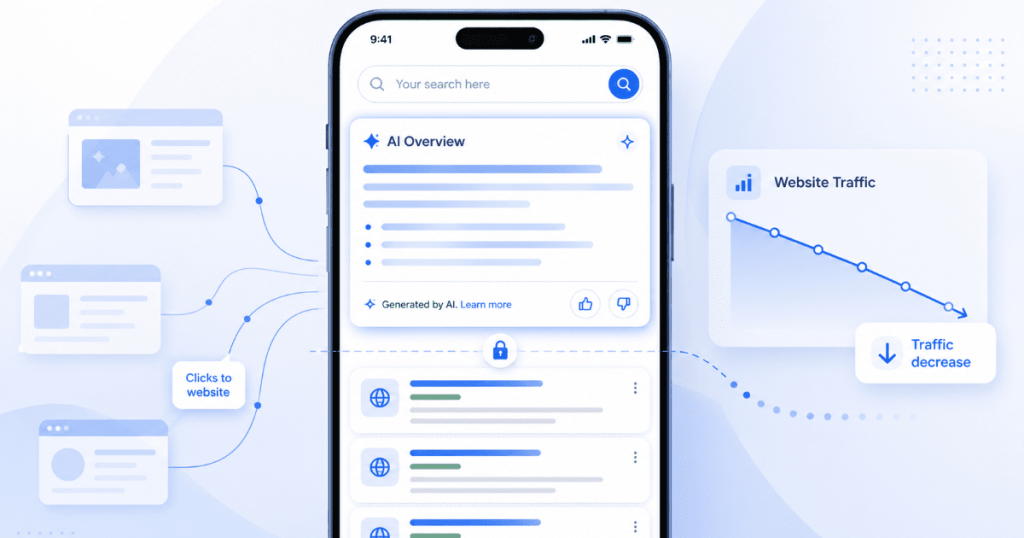
Google’s AI Overviews are AI-generated response summaries that appear at the top of search results. They pull text and citations from web sources to answer user queries directly on the page.
Top Ranking Factors
- Strong Organic Rankings: About 70% of AI Overview citations come from Google’s top 10 organic search results.
- Answer Clarity: Content must be clear, direct, and structured with simple headings, bullet lists, or tables for easy AI extraction.
- Topical Authority: Comprehensive coverage of a subject across an interconnected cluster of pages builds the trust needed for citations.
- Freshness: A large majority of cited links come from content published or updated within the last few years.
- E-E-A-T (Experience, Expertise, Authoritativeness, and Trustworthiness): Credible, factual content performs significantly better, especially on informational topics.
How to Optimize Your Content
- Format for Extraction: Use clear definitions, short paragraphs, and structured data like schema markup or HTML tables.
- Target the Right Triggers: Focus on informational and specific long-tail keywords (3 to 5 words) that frequently prompt generative results.
- Build Brand Mentions: Earn citations and references on other authoritative industry domains to boost overall brand trust.
How to Track AI Overviews
- Use specialized rank-tracking tools like the Semrush AI Overview Research guide to filter organic rankings and monitor domain visibility.
- Monitor competitor gaps and citation rates over time using dedicated AI Overviews Rank Tracking Tools to see which of your URLs are referenced.
How AI Overviews differ from traditional organic results
Unlike traditional organic results, AI Overviews generate a synthesized answer on the spot with citations embedded inside it. The user may never scroll to the blue links below. This distinction is what makes them so important for SEO strategy. AI Overview optimization targets citation inside the answer.
Why being cited in an AI Overview is a new SEO priority
AI Overviews have cut organic CTR by 61% on affected queries. For pages that sit below an AI Overview without being cited, that traffic loss is unrecovered. But there’s a counterweight: getting cited inside an AI Overview now earns 35% more clicks than holding a traditional ranking alone
Conductor’s analysis found 25.11% of searches triggered an AI Overview in Q1 2026, up from 13.14% in March 2025 — nearly double in twelve months. In commercial verticals, BrightEdge puts that figure closer to 48%. Either way, citation has become a primary visibility channel (Conductor).
The relationship between AI Overview citations and organic traffic
Being cited in an AI Overview still doesn’t replace organic traffic. Pages that earn citations tend to see higher-quality clicks: users who click through from an AI Overview have already read a summary that referenced your content, which means they arrive with stronger intent and context than a typical organic click.
AI Overviews Ranking Factors: The Breakdown
Rankings are influenced by Google’s core ranking systems (PageRank, Reviews, Helpful Content) alongside AI models, including Gemini and MUM, and databases like the Shopping Graph and Knowledge Graph.
Topical authority and E-E-A-T signals
Topical authority and E-E-A-T sit at the top of that stack. The June 2025 Core Update made topical authority stronger as a ranking input. Now, sites that have interlinked content clusters consistently outperform broader, shallower sites by up to 30%.
Content comprehensiveness and query coverage
A page that answers the core question but ignores adjacent questions a user might have is less citeable than one that covers the topic fully. Google’s AI system is looking for the best extractable passage for a given query, and a comprehensive page gives it more to work with. This is why thin pages that address one narrow intent rarely earn citations, and why content clusters outperform isolated pages.
Structured, scannable formatting (headers, lists, tables)
AI Overviews favor content that is easy to extract. Headers signal topic boundaries, lists make items individually parseable, and tables allow direct comparison. All of these reduce the work the AI system has to do to pull a coherent answer.
Page-level trust signals (author bios, citations, sources)
At the page level, trust signals tell Google’s AI that the content is attributable and verifiable. A named author with a linked bio, external sources cited and linked, a visible publication date, and no unsourced statistical claims all contribute. 96% of AI Overview citations now come from verifiably authoritative sources, which means pages without these signals are effectively excluded from most citation consideration.
Site-level authority and backlink profile
Site-level authority — built through backlinks from relevant, trusted domains and third-party brand mentions — signals to Google that the domain is recognized as reliable in its field. This matters for AI Overview selection because the system evaluates source credibility at both the page and domain level. A strong backlink profile doesn’t guarantee citation, but a weak one is a meaningful disadvantage.